Showing posts with label Unit 1 - Contextual Studies. Show all posts

Friday, 30 November 2012

New Wave Edited Piece


This is my Final New Wave edited piece. 

What I was Trying to Accomplish
When reviewing the footage i had collected over the weeks, i noticed two main characters, Sammi and Will, so i decided to focus on them. The new wave films that i had analysed before starting did not have very happy tales to have, to i wanted to follow suit.

i decided to make my narrative a love tragic love story, almost like romeo and juliet. when i decided to do this i needed to decide on a song to run throughout. (the reason  a i decide to use a song instead of the dialogue from the footage was because no particular script or narrative was followed when filming, as we were capturing techniques). i chose to use the song Angels on the Moon by Thriving Ivory, because this song mirrored the mood i wanted to portray throughout my film.

Analysis/reflection 

Editing

Text
I got the idea of adding text and dictionary definitions from the film if.... (1968) that I studied for my Contextual Study (Unit 1). At the beginning of if…. there is a saying shown first, setting up one of the many issues that are raised.  

When I decided to add text into my short film I put one at the beginning and the end. I did this because it helps set up the film, but also helps to show a definitive ending to the film, and the theme of life and death. I feel that it helps to add emphasis on the narrative that everything comes to the end, and by having them fade in and out I wanted to demonstrate that you become more defined as you grow, fading into life and standing out more and as you get older and eventually die you fade out of life.

The first time you are introduced to the characters they are seen in a dream like way, with the background spinning past. This shot was produced in an innovative way, using a round-a-bout to move the camera. This helps to fit my film into new wave as in new wave innovate camera movements are used, not only does it create interesting shots but also is a cheap way to move the camera and capture shots, using apparatus that are readily available. 

This movement helps with the narrative that I was trying to create by showing how in the characters minds the world revolves only around them.  I emphasized the dream like sense by slowing the clips down, this showing also how time revolves around them and when they are together time slow down for them. This will later contrast with how time speed ups nearer the end, -seen through jump cuts. This point that people think they have all the time in the world together, when really their time together can be cut short, as it is in my short film, catalyzes the narrative.

The second time the couple are seen they are in a darker environment and I tried to make the scene more nightmarish compared to the dream like encounter before. I have done this to move the narrative along trying to foreshadow the darkness that is to come. I have also done this with Kuleshov editing, showing the female looking at the male, who then becomes a skeleton, -this foreshadows the males death that is to come. Also I have edited the female and the doll together –using the same female shot used when she was looking at the male and skeleton- and done this to show how after he dies she will become inanimate and emotionless without him.

Also in the nightmare scene the male looks directly at the camera with the doll waving. Two things are done here; one, I have included this clip as it breaks the forth wall and directly addresses the camera, this adding to new wave, and two; the doll waving helps to once again show how the female is waving goodbye to everything she knows now and the happy life she has with the male.

Continuity
When we seen the female walking down the road my lack of continuity can be seen very clearly; once when she passes the same shop twice (the blue run down store) and how she is not passing a man with a dog in one shot then when it cuts to the next shot she is. These continuity errors are left in deliberately, as new wave does not concentrate that much on continuity but rather the issues and social context within the film that fuel the narrative.

The audiences viewing habits are challenged by them not really knowing how the female got from one place to the other, one minute she’s in the park with the male the next she is walking down the road, then they are eating dinner in a surreal environment (created by the low key lighting, the mise en scene, like the doll, and the editing), then the female is stood alone and then at a grave. I have also tried to challenge the audience by not giving then a time period that these events have happened across. I have showed time moving along by clocks being seen, long tracking shots, jump cuts and as said before slow motion shots. I also feel that the low angle shot of the leaves helps to move time along, from the way the camera is panning. The sudden scene changes help to show how life suddenly changes and the next step is unpredictable.

Tracking Shot
Long tracking shots are typical of the new wave genre. A good example of this in the french new wave film Les quatre cents coups. I included a long tracking shot into my short film, this is where trees and bushes are seen towards the end. i did this shot through an open car window. 


Monday, 26 November 2012

OH&S of Oxford After


When visiting Oxford we filmed in locations that were not originally planned, therefore before entering the establishments we needed to consider the health and safety risks.

Unplanned Locations
The Truck Music Store 
This was a small record store and café. so before we all entered the shop with all the equipment two of us entered to ask for permission. when we were granted permission to film in the shop we entered carefully with the equipment and placed it to one side. this kept the equipment out of the way from us, the staff, other customers and saved use trying to maneuver it through the small spaces provided.

Mr Simms Sweet Shop
Mr Simms Sweet Shop was located across the road to where we where. As we had predicted the high traffic flow of Cowley Road, we were careful when crossing; distributing the equipment evenly, making sure no straps were hanging down that we could trip over; and crossing where the road was clear.
Like with the Music Store, we asked permission before lugging all the equipment into the small sweet shop. When we were given permission, we moved all the equipment in and put it to the side, out of the way. In this shop we had to be more careful when moving ourselves and the equipment as there was a lot of items close to the edge of shelves, including glass jars.
We also filmed outside of the shop, both in front of the shop and across the road from it. we tried to situate ourselves out of the way of passing people as best as we could. but the paths were narrow, so we did get in the way. so to avoid this the best we could we sped the process of filming up, so that we were obstructing the pavement for only a short period of time.

Back Alley
This back alley was well lit, so filming down there did not seem dangerous - and turned out not to be. When filming down here we noticed that there was construction work, but it was not being worked on; so the dangers were lessen and we felt that we could film in front of the fencing safely. with this said we were still weary of the construction, staying a safe distance away and not leaning against the surrounding fence.
to begin with there were no other people down the alley way, so we were free to film freely and place or equipment were needed. as the minutes passed people started to use the alley, so we had to become more cautions where we placed ourselves and the equipment.

Unexpected OH&S of Planned Locations 
The Turf Tavern 
When we arrived at the Turf Tavern it was a small hidden pub so we had to straight away be weary of the equipment causing and damage to the surroundings and of ourselves getting in the way. We didn't not come across and aggressive people there and we occurred no accidents, from slipping, like thought. however there was an open fire outside the tavern, initially we stayed away but I though that we would be able to get some nice footage from this. so before I started filming the fire, I established a safe distance, where the camera and my hands would hot get too hot and made sure that the camera strap was securely around my neck, as I planned to film above the fire.
By considering theses things I was able to prevent any damage to the camera and and burns to myself.

Jericho
We never made it to Jericho so there was not rick of the canal. however we did film from a bridge of another canal, so the rick of equipment lose was still present. to avoid this before filming over the bridge, once again, we made sure the straps were securely around our necks. 

Overall
We did not attain any injuries or damage to the equipment. this is due to the ahead planning, not only before visiting Oxford  but also before enter shops and new locations where in Oxford  by researching the areas we were planning to visit we were able to predict OH&S issues that may not have been an issue when filming in Nuneaton  the high density of bikes for instance. also by considering each location separately  as a pose to Oxford as a whole, we were able to expand our awareness and be more prepared for any health and safety problems that may have occurred. 

Oxford


Why Oxford?
Oxford offered a different environment to collect footage in and allowed use to venture out of the comfort zone of Nuneaton.  We where challenged to fend for ourselves on a location and we encouraged to pre plan and organised ourselves before and when we were there. 


The weather wasn't the best but was also not a suveriour issue, as light drizzle was predicted but it never rained. The day had a lot of over cast and was very dull; however i found this to be a plus as is stopped the nautral lighting from being intermissant, so all the footage had the same lighting, this would later come in handy for when editing and trying to keep continuity (even though this is not a problem in new wave films).


Filming On Location
Location: Oxford
Date: 22nd October 2012

Brief: To practise filming in a location outside of nuneaton; capture the essence of the area and film colourful environments. 

·      Equipment Used
·      Canon 500D
·      Canon 600D x2
·      Fluid Head Tripod
·      Small Lumix digital camera 
·      Boom Microphone
·      Spared, Cleared SD Cards
·      Reflector
·      Umbrella 


·      Experience
      I really enjoy filming in Oxford; it was more picturesque and had a larger variety of environments than those found in Nuneaton. I found the experience to be different filming on location in Oxford compare to filming on location in Nuneaton, as people were more accepting of use filming in the street and they tended to stare more and just carried on with what they were doing. I liked this as we didn't have to waste time explaining to curious people what we were doing, we could just get on with filming and move along. Because the people there were more excepting of use filming it was easier to ask for permission to film in shops, in particular at the Truck Music Shop, as the man who ran it said that he had to go throughout the same experiences when he did a film course so he was more than willing to let us use his shop to film in. 

Problems 
For the majority of the day everything ran smoothly, but we did rub into a few problems.
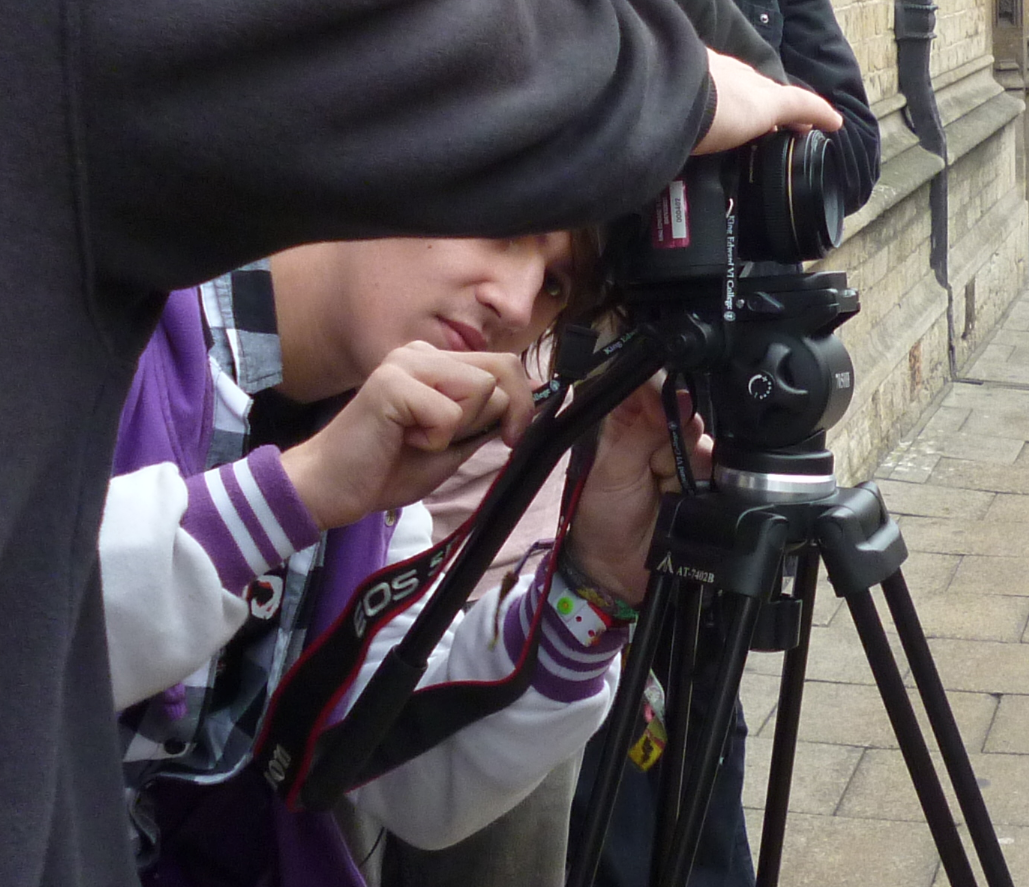
The first problem we can across was a minor one; the permission sheets we forgotten. However Sammie had the permission slip on a memory stick so we found a library nearby, by looking on google maps in our phones, then we printed one off and photocopied several.
The second problem was an issues as the tripod plate was missing where the camera attaches. at first we  thought that we would not be able to use the tripod, which was annoying as we had found a colourful street that we wanted to get a pan of.  but we managed to secure the camera to the tripod with our college lanyards. Surprisingly this worked effectively and the camera was steady and secure on the tripod, but as an extra procaution we kept our hand on the camera at all times when attached to the tripod.

When we were back at college the next day and reviewing the footage we had collected we realised that our interview with the boom mic was muffled and the gentleman could not he heard, only the music coming from the speaker, which the boom was next to. when using the boom mic, the man was being pick up mores than the music, so we thought that the positioning of the boom was okay. (I will discuss this further in a later post).

Cowley Road 
A - Where Bus Was Parked, B - Cowley Road
Cowley Road was the first location we were going to film; we decides this because it was the farthest location away from where the bus had parked. even though we knew it was far it took longer than anticipated, one, because it was far away and two, because we stopped on more than one occasion to shoot places we came across on the way to the location that looked interesting. These frequent stops did effect our timing schedule, so we didn't have enough time to visit the last destination we had planned to go to - Jericho- but, it did provide us with interesting, useful and different footage that we hadn't intended on shooting.

Firstly when we where walking to Cowley Road along High Street we came across some very colourfully painted building and straight away we were able to cover one of the brief points to capture different coloured environments. This is where we first realised that we did not have the tripod plate and had to attach the camera by lanyards. we could have used hand held camera but we felt it would look better on the tripod. 


Along the way we passed a small alley as decided to shoot some footage here as it was different to anything we had seen in Nuneaton. This footage gave a indication to the place where we were, and i also feel that it fits in with the New Wave themes capturing real areas. not only because of this but also, the people passing by look at the camera and this shows a real environment with real people and not actors. 
Also in the alley we were able to contribute to one point in the brief of capturing colour. we did this by filming the brightly painted houses that were down the alley. 
 

Mr. Simms Olde Sweet Shoppe 
A - Mr. Simms, B - Cowley Street
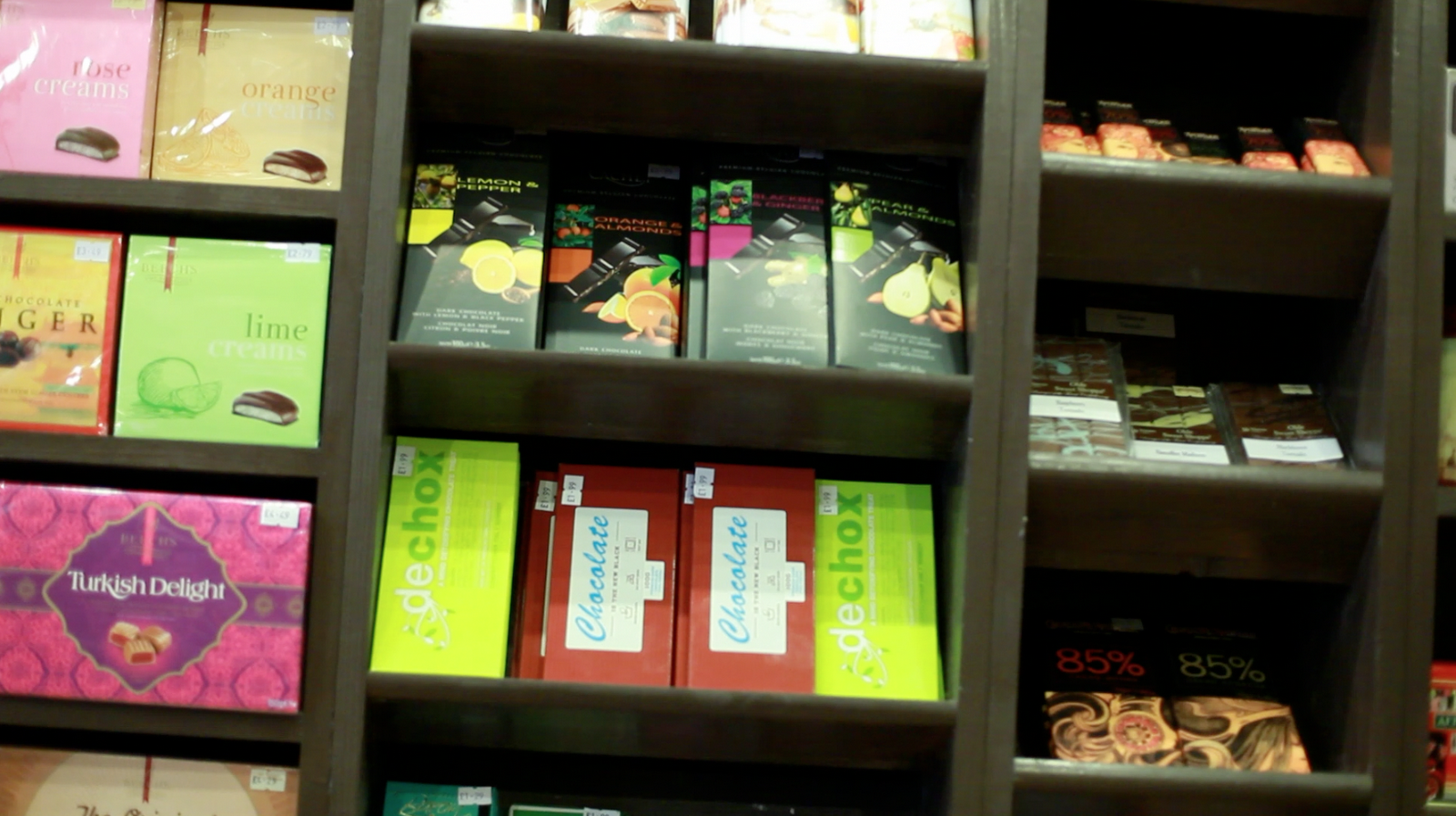
Another stop along the way was an old-fashioned style sweet shop that was brightly coloured, called Mr Simms Olde Sweet Shoppe. We decided go go inside and collect footage here as we felt the shop offered a vast amount of colour and interesting shoots and lighting. we had to experiment with the white balance as the lighting in the shop caused to footage to have an orange tinge to it. we knew it was the lighting in the shop and no the white balance being off on the camera because the white balance that the camera was set on didn't distraught the footage we gathered outside. We upped the k value to add blue to the footage which made the images look much more realistic and the array of colours could be seen more clearly. 


Screen shot of the footage without adjusting the white value. The colours all have an orange/red feel to them and causes the colours to almost blend in together. 

Aperture: f/22.5, Shutter Speed: 1/500, ISO: 3200 and White Balance: 8000k  

Screen shot after adjusting the white balance to about 2500k. The colours are more defined and vibrant.

We left the aperture and shutter speed the same but changed the ISO setting to 64 and the White Balance to 2500.

Before any shooting we had to make sure we had permission from the store owner/manager and get them to sign the release form. We approached one of the staff members, explaining our project and what we would like to shoot inside the shop and from this we gained permission and had the release form signed as long as we did not film any of the customers that came into the stop. We happily agreed and because the shop was fairly quiet for the most of it it as easy not to film any customers. 


After we had permission we set up the equipment, keeping the equipment we were not using out of the way tucked in one corner so that we didn't trip over it and neither did any customers that were in the shop or going to be. because the shop was fairly small we were very careful of how we manoeuvred around the shop and where we placed our equipment, so not to damage the shop of cause harm to any of the people in the shop or ourselves.

Footage Analysis

Off Tilt Camera 
       For most of the shots that we tool in Mr. Simms we ignored the rule of thirds to emphasis the subject's symmetry. This worked for the mostly and the symmetry was seen, however the camera was at a slight downward tilt to the right. This could have been down to the camera being attached to the tripod by lanyards, but if we had noticed at the time (which i didn't until the next day, when reviewing the footage) the tripod could have easily been raised on the right side to even the tilt out. When a symmetry shot was taken without the tripod there was no tilt and the symmetry was clear.

This is a screen shot that shows a downward tilt to the right during a shot. this tilt is made more noticeable because of the symmetry within the shot, which was meant to be even.  This shot was taken on the fluid head tripod.
Here is a screen shot that shows an hand held shot with no tilt and the symmetry is seen and can be appreciated. 


The above clip shows the slight tilt that was on the camera

       We did purposely take a shot that was completely off balance. this gave the footage a dream like appearance as well as the pastel colours that were in the shot, and help to fit one of the New Wave techniques of unusual camera angle. 


Colours 
Pastel Colours 
Bright Colours
We gathered a vast scale of colours when filming in and around Mr. Simms. Inside we were able to capture light pastel coloured scenes and one the other end of the scale vibrant bright colours. and when we ventured outside the colour where duller, with browns and greys. 


Also when we went outside and crossed the road to get some footage of the front of the shop the grittier side to oxford was seen; this was only about twenty metres from the picturesque scene. Here social realism can be seen. 


We eventually made it to Cowley Road after multiple stops and shot a small amount of footage in 'grittier' street and got some lovely shots of a large wall of graffiti, providing brilliant contrast to the earlier footage of the day. 

A few seconds past the wall there was a very colourful bench; this would not only help to fulfil one of the briefs criterion of capturing colour but I thought that this would be a perfect opportunity to get footage from a different angle (this off angle shot is hep to meet a New Wave technique of unusual camera angles).  We used a small aperture, f/22, so all of the shot is in focus.  As for the positioning of of the bench, I feel that the bench is nice and central and the set up of the bench  drowns the eyes and focus in.

Truck Music Store
After this we headed straight for the record store that we had intended to go to in the first place, once again we had to ask for permission, which the shop owners were more that happy to give, and after a short explanation of what we intended to do we began setting up. We also took this opportunity to ask the manager if would like to take part in a short interview which gave us chance to set up and make use of the boom microphone ( I will disgust this in more detail later on). 

The Turf Tavern 
From here, we went on to find The Turf Tavern, a small famous pub situation off an alleyway in the heart of Oxford, and again got permission from a member of staff to film there and proceeded to get some beautiful shots of the very picturesque location.

We got some shots of fire, as this was a new kind of footage that we had not obtained before. Also we introduced a character in to our footage so that we did not just have random clips from different places within Oxford  the character will allow us later to edit the footage together and create a narrative. 


Overall 
In  the end, I feel that the day was a success; helped by the planning done the day before. We managed to collect footage that was on the brief as well as extra footage that we did not intend to film.  because we capture more footage from other unscheduled areas of Oxford I am not to concerned that we didn't manage to make it to Jericho. 


New Wave Conventions Checklist


·      Hand-held 
All of the footage that I filmed I did hand held. this was mainly down to the fact that to attach the camera to the tripod I would have to waste time trying to tie it to the tripod head; and as we had a limited time in Oxford, I didn't want to waste any time with that when I could just hold the camera (and as hand held footage is an aspect of new wave I wasn't too concerned with using the tripod).

·     Long takes/tracking shots ✗ 

·     Youthful iconoclasm 
I feel that this was capture in the record shop, and showed the difference between the youth of Oxford and Nuneaton. 

·      Political and/or social troubles captured ✗ 
I feel that there were not that many obvious political or social problems. unlike the area we visited in Nuneaton  the areas of Oxford were in better condition, with no litter visible on the streets, and the little litter I did manage to find was in a open drainage system that was hidden away. also there wasn't any vandalism, like graffiti - even though there was a wall of graffiti it added beauty to the area rather than ruining it. 

·      Homemade accessories/innovative camera movement ✗  
There were not any opportunities to practice this new wave technique. the only one that we would have had would have been a long tracking shot on the bus, however the windows did not open so the reflection and glare off the glass would have been visible in the footage. 

·      Documentary feel ✗ 
Personally I feel that we achieved this, somewhat. All the people in the clips were not actors - even thought they seem used to the camera's, maybe because of the high tourist numbers in the area. Some of the by passes look directly at the camera, this i feel helped with the documentary feel. What also adds to the documentary feel is the interview we conducted in the record store. CLIP

·      Friends used to act or as crew ✓ 
We introduced Jack as a character  this was done to help with future editing and give a narrative  but also helped to fit this new wave criterion of friends as crew and actors to keep a low budget.  CLIP

 ·  Unbiased and personal realism ✓  
(In this case the realism was unbiased, as we did not completely know what to expect when visiting Oxford. We where fortune enough to be able to catch both sides of Oxford; the side that attracts tourists and the realist side, of graffiti and dying businesses.  

·      Real locations/ environments ✓ 
As the main brief was to film the streets of Oxford, this was checked straight away; we also managed to shoot in real locations of shops (something we had not done before)

·      Improvised dialogue ✓ 
During the interview with the record store managers we did a Q&A session to create spontaneous dialogue. 

·     Take the audience out of the film/direct address to the camera ✗ (

·      Establishing shots 
We only took a few establishing shot and they were from ground level and captured the essence of the area. An establishing shot that we took of the building across the street, not only check the new wave point of establishing shots but also tick the brief by capturing colour. CLIP

·      Rapid movement 


·      Unusual camera angles 
This was done in Mr Simms Sweet Shop. (Explained more above)

OH&S of Oxford Before


Each location that we are planning to visit in Oxford will present different health and safety issue. To be prepared for these I have made a separate OH&S list for each location.


General OH&S
Manual Handling - we will be caring heavy equipment for an extended period of time. to prevent any back, neck of limb strain we need to make sure that we regularly rest and rotate the equipment among the group, so that not only one person is left carrying the heavy tripod (for example) for the duration of the scout.


The Turf Tavern 
Slipping - Even thought this could happen in any scenario I feel that because the turf tavern in a pub there will be a higher risk of spilt drinks. So when we are at this location we will need to be more aware of this.

Violence - Also due to the fact that it is a pub, their may be people there that have high alcohol levels. so we will need to be weary of these people, making sure that any violent situations that arise are reported to the manager straight away. also we will have to be careful of the equipment around them, in case they cause any damage to them from being too close.

Cowley Road
Main Shopping Area and Road -  Cowley Road has a high level of road traffic and pedestrian traffic, with limited space. When we are out filming on this road we should
                 - be aware of other people, and stay as much out of there way as possible. this will avoid conflicts, damage to the equipment and injure to ourselves and others.
                 - be aware of cars. we may need to cross roads when venturing down Cowley Road. If this is require we should take care when crossing the road, no only because of the dense traffic flow but also as we are carrying a lot of heavy equipment that may hinder the process of crossing the road.
                  - be aware of bikes. Oxford has a high density of bike users, so when crossing the road we need to watch for bikes as well as cars.

Jericho
Community Area - Jericho is a very community orientated area, so when we visit this location we need to make sure not to unset the locals. be as polite, quiet and quick as we can, with disturbing the area.

Canal - Also the Oxford Canal runs through Jericho. This will produce some nice footage and if we do plan to film near the canal we need to be sure not to get to close, so we don't fall in; make the ground is stable before setting up any equipment, so we don't loose our footing; and make sure all the equipment we are using it secured to our persons.

Oxford Preparation


Oxford Preparation
By going to Oxford we where hoping to gather footage that was not readily available in or around Nuneaton and as Oxford is an  intriguing  and architectural place we thought this would be a good place to film. As we where venturing so far from Nuneaton and only for one day we needed to make sure that we had everything laid out, like the equipment we needed, knowing how to use it all, specific locations that we wanted to film, what we wanted to capture (mainly different environment than that of Nuneaton) and have a route mapped out so that we don't waste time walking around trying to look for certain places (as time was so limited anyway). So we assembled an equipment list.

Equipment list:                                                   
Canon 500D                                                        
- Canon 600D x2                                                   
- Small Lumix digital camera (for documenting)        
- Fluid Head Tripod
- Boom Microphone
- Spare, Cleared SD Cards 
- Reflector 
- Umbrella (in case it starts to rains)

Before leaving for Oxford we also have to strongly consider the health and safety risks, as we may come across some risks that we have not already as we are going to a completely different environment. some risks involve, vagabonds, muggers, car accidents and cyclist on the pavements. to avoid these dangers we need to, make sure we stick together, know where we are going, do not approach or be approach by people that look dangerous or suspicious, carry as little equipment as possible, be aware of our surrounding and don't get peoples way and don't venture to places that are far outside of our original scouted areas (Cowley Road,  The Turf Tavern and Jericho).  
These are the location that we have planned to go to when in Oxford


We also prepared and practised with the boom microphone the day before we went to Oxford. We did this as it was part of the brief to test the boom microphone and the cameras internal microphone, and as we had not used the boom microphone before we needed to practice with it and the set up. 


As well as learning how to use all the equipment we made sure that all the cameras were fully charged and that  we had spared SD cards that were empty. 

Sunday, 25 November 2012

Editing

Editing
Film editing is the invisible art of motion picture, when it is well-practised, the viewer can become so engaged that he or she is not even aware of the editor's work. The film editor works with the raw footage, selecting shots and combining them into sequences to create a finished motion pictureThe job of an editor isn't simply to mechanically put pieces of a film together, cut off film slates, or edit dialogue scenes. A film editor must creatively work with the layers of images, story, dialogue, music, pacing, as well as the actors' performances to effectively "re-imagine" and even rewrite the film to craft a cohesive whole. Editors usually play a dynamic role in the making of a film.

Continuity

Continuity is a film term that suggests that a series of shots should be physically continuous, as if the camera simply changed angles in the course of a single event. For instance, if in one shot a beer glass is empty, it should not be full in the next shot. Technically, continuity is the responsibility of the script supervisor and film director, who are together responsible for preserving continuity and preventing errors from take to take and shot to shot. The script supervisor, who sits next to the director during shooting, keeps the physical continuity of the edit in mind as shots are set up. He is the editor's watchman. If shots are taken out of sequence, as is often the case, he will be alert to make sure that that beer glass is in the appropriate state. The editor utilizes the script supervisor's notes during post-production to log and keep track of the vast amounts of footage and takes that a director might shoot.


Montage
Montage was the essence of the cinema. Today montage has a completely different connotation than it used to.  There are at least three senses of the term: French film, Soviet filmmaking and classic Hollywood cinema. 

French Film 
        In French film practice, "montage" has its literal French meaning (assembly, installation) and simply identifies editing.  
        The New Wave filmmakers were linked by their self-conscious rejection of the literary period pieces being made in France and written by novelists, their spirit of youthful iconoclasm, the desire to shoot more current social issues on location, and their intention of experimenting with the film form.  
        Filming techniques included fragmented, discontinuous editing, and long takes. The combination of objective realism, subjective realism, and authorial commentary created a narrative ambiguity in the sense that questions that arise in a film are not answered in the end.French New Wave cinema became very aware of editing and makes this known among the audience as well. One way that awareness is created is by jump cuts which is the type of edit that causes the subject of the shots to appear to "jump" position in a discontinuous way.

Sequence from Breathless that shows Jump Cuts       A sequence I put together to show Jump Cuts


Soviet Filmmaking
Soviet Filmmaking of the 1920s, "montage" was a method of juxtaposing shots to derive new meaning that did not exist in either shot alone. Soviet editing techniques show that it is not the content of the images in a film which is important, but their combination.  An example of this is the Kuleshov effect, which I will discuss later on. 


Classic Hollywood Cinema
In Hollywood cinema, a montage sequence is a short segment in a film which narrative information is presented in a condensed fashion.


The Kuleshov Effect
Lev Kuleshov is a Russian filmmaker who edited together a short film in which a shot of an expressionless face was alternated with various other shots; a plate of soup, a girl in a coffin and a woman on a divan. Audiences believed that each time the faces expression had changed and they praised the subtle acting. The reality, of course, is that the same clip of the actor's face was re-used, and the effect is created entirely by its superimposition with other images. 
            Kuleshov used the experiment to indicate the usefulness and effectiveness of film editing. The implication is that viewers brought their own emotional reactions to this sequence of images, and then moreover attributed those reactions to the actor, investing his impassive face with their own feelings. Kuleshov believed this, along with montage, had to be the basis of cinema as an independent art form.


Eisenstein Theory
Eisenstein was a pioneer in the use of montage. His writings and films have continued to have a major impact on subsequent filmmakers. Eisenstein believed that editing could be used for more than just expounding a scene or moment, through related images. Eisenstein felt the collision of shots could be used to manipulate the emotions of the audience and create film metaphors. He believed that an idea should be derived from the juxtaposition of two independent shots, bringing an element of collage into film.

A Baby in a Carriage Falling Down the "Odessa Steps"


D.W. Griffith
D.W. Griffith was an American director who, more than anyone of the silent era, saw film's potential as an expressive medium, and exploited that potential. Griffith played a number of roles as an actor before agreeing to move behind the camera as a director. As a director Griffith took the raw elements of movie making as they had evolved up to that time and wrought a medium of extraordinary power and degree - elements such as lighting, continuity, editing and acting. 
       D.W. Griffith developed classical cutting -where a sequence of shots are determined by the scene's dramatic and emotional emphasis rather than physical action, Griffith for example would edit love scenes in long lyrical takes- as well as developing a variety of editing principles he believed made cutting invisible, such techniques as eye-line match. also Griffith was the first to use close-ups for psychological reasons instead of physical reasons. his cross cutting style was hallmarked in Early short films such as A CORNER IN WHEAT (1909), FIGHTING BLOOD (1911), and UNDER BURNING SKIES (1912), using these cross-cut edits to build tension, acute observation of details to heighten reality, and the use of the camera as a vehicle for expounding his views on society. 

             Cross Cutting in Fighting Blood                                  Example of Eye-Line Match