Definition
Oedipus complex, in psychoanalytic theory, a desire for sexual involvement with the parent of the opposite sex and a concomitant sense of rivalry with the parent of the same sex; a crucial stage in the normal developmental process. The term derives from the Theban hero Oedipus of Greek legend, who unknowingly slew his father and married his mother; its female analogue, the Electra complex, is named for another mythological figure, who helped slay her mother.
The Oedipus Complex according to Freud
Oedipus complex denotes the emotions and ideas that the mind keeps in the unconscious, via dynamic repression, that concentrates upon a child's desire to sexually possess his/her mother, and kill his/her father. Sigmund Freud, who coined the term "Oedipus complex" believed that the Oedipus complex is a desire for the mother in both sexes (he believed that girls have a homosexual attraction towards their mother).
In classical Freudian psychoanalytic theory, child's identification with the same-sex parent is the successful resolution go the Oedipus complex and of the Electra complex; key psychological experiences that are necessary for the development of a mature sexual role and identity. Sigmund Freud further proposed that boys and girls experience the complexes differently: boys in a form of castration anxiety, girls in a form of penis envy; and that unsuccessful resolution of the complexes might lead to neurosis, paedophilia, and homosexuality. Men and women shot are fixated in the Oedipal and Electra stages of their psychosexual development might be considered "mother-fixated" and "father-fixated". In adult life this can lead to a choice of a sexual partner who resembles one's parent.
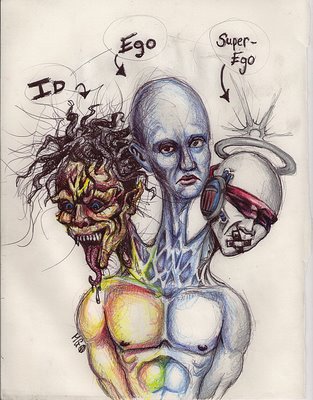
In order to develop into a successful adult with a healthy identity, the child must identify with the sae-sex parent in oder to resolve the conflict. Freud suggested that while the primal id wants to eliminate the father, the more realistic ego knows that the father is much stronger.
According to Freud, the boy then experiences what he called castration anxiety - a fear of both literal and figurative emasculation. Freud believed that as the child becomes aware of the physical differences between males and females, he assumes that the female's penis has been removed and that his father will also castrate him as a punishment for desiring his mother.
In order to resolve the conflict, the boy then identifies with his father. it is at this point that the super-ego is formed. the super-ego becomes a sort of inner moral authority, and internalisation of the father figure that strives to suppress the urges of the id and the ego act upon these idealistic standards.
 The Electra complex derives from the 5th-century BC Greek mythologic character Electra, who plotted matricidal revenge with Orestes, her brother, against Clytemnestra, their mother, and Aegisthus, their stepfather, for their murder of Agamemnon, their father.
Initially, Freud equally applied the Oedipus complex to the psychosexual development of boys and girls, but later modified the female aspects of the theory as "feminine Oedipus attitude" and "negative Oedipus complex" (Carl Jung in 1913, proposed the Electra complex to describe a girl's daughter-mother competition for psychosexual possession of the father).
In the phallic stage, a girl's Electra complex is her decisive psychodynamic experience in forming a discrete sexual identity (ego). Whereas a boy develops castration anxiety, a girl develops penis envy rooted in anatomic fact: without a penis, she cannot sexually possess mother, as the infantile id demands. Resultantly, the girl redirects her desire for sexual union upon father, thus progressing to heterosexual femininity, which culminates in bearing a child, who replaces the absent penis.
Freud thus considers a girl's negative Oedipus complex to be more emotionally intense that that of a boy, resulting, potentially, in a woman of submissive, insecure personality; thus might an unresolved Electra complex, daughter-mother competition for psychosexual possession of father, lead to a phallic-stage fixation conducive to a girl becoming a woman who continually strives to dominate men, either as an unusually seductive woman (high self-esteem) or as an unusually submissive woman (low self-esteem).
The Oedipus Complex according to Lacan
The Oedipus complex is, for Lacan, the
paradigmatic triangular structure, which constrasts with all dua; relations.
The key function in the Oedipus complex is thus that of the father, the third
term which transforms the dual relation between mother and child into a triadic
structure. The Oedipus complex is thus nothing less than the passage from the
imaginary order to the symbolic order, ‘the conquest of the symbolic relation
as such’. The fact that the passage to the symbolic passes via a
complex sexual dialectic means that the subject cannot have access to the
symbolic order without confronting the problem of the sexual difference.
Lacan analyses this passage from the
imaginary to the symbolic by identifying three ‘times’ of the Oedipus complex,
the sequence being one of logical rather than chronological priority.
The first time of the Oedipus complex is
characterized by the imaginary triangle of mother, child and phallus. Lacan
calls this the pre-oedipal triangle. Prior to the invention of the father there
is never a purely dual relation between the mother and the child but always a
third term, the phallus, an imaginary object which the mother desires beyond
the child himself.
In the first time of the Oedipus complex,
then, the child realizes that both he and the mother are marked by a lack. The
mother is marked by lack, since she is seen to be incomplete; otherwise she
would not desire. The subject is also marked by a lack, since he does not
completely satisfy the mother’s desire. The lacking element I both cases is the
imaginary phallus. The mother desires the phallus she lacks, and the subject
seeks to become the object of her desire; he seeks to be the phallus for the
mother and fill out her lack. At this point, the mother is omnipotent and her
desire is the law. Although this omnipotent may be seen as threatening from the
very beginning, the sense of threat is intensified when the child’s own sexual
drives begin to manifest themselves. This emergence of the real of the drive
introduces a discordant mote of anxiety onto the previously seductive imaginary
triangle. The child is now confronted with the realization that he
cannot simply fool the mother’s desire with the imaginary semblance of a
phallus – he must present something in the real. Yet the child’s real organ is
hopelessly inadequate. This sense of inadequacy and impotence in the face of an
omnipotent maternal desire that cannot be placated gives rise to anxiety. Only
the intervention of the father in the subsequent times of the Oedipus complex
can provide a real solution to this anxiety.
The second ‘time’ of the Oedipus complex is
characterized by the intervention of the imaginary father. The father imposes
the law on the mother’s desire by denying her access to the phallic object and
forbidding the subject access to the mother. Lacan often refers to this
intervention as the ‘castration’ of the mother, even though he states that,
properly speaking, the operation is not one of castration but of privation.
This intervention is mediated by the discourse of the mother; in other words,
what is important is not that the real father step in and impose the law, but
that this law be respected by the mother herself in both her words and her
actions. The subject now sees the father as a rival for the mother’s desire.
The third ‘time’ of the Oedipus complex is
marked by the intervention of the real father. By showing that he has the
phallus, and neither exchanges nor gives it, the real father
castrates the child, n the sense of making it impossible for the child to
persist in trying to be the phallus for the mother; it is no use competing with
the real father, because he always wins. The subject is freed
from the impossible and anxiety-provoking task of having to be the phallus by
realizing that the father has it. This allows the subject to identify with the
father. In this secondary (symbolic) identification the subject transcends the aggressively
inherent in primary (imaginary) Oedipal identification with the father.
Since the symbolic is the realm of the law,
and since the Oedipus complex is the conquest of the symbolic order, it has a
normative and normalizing function: ‘ the Oedipus complex is essential for the
human being to be able to accede to a humanized structure of the real’. This normative function is to be understood in reference to both clinical
structures and the question of sexuality.
In perversion, the complex is carried
through to the third time, but instead of identifying with the father, the
subject identifies with the mother and/or the imaginary phallus, ths harking
back to the imaginary pre-oedipal triangle. A probia arises when they cannot make the transition from the
second time of the Oedipus complex to the third time because the real father
does not iintervene; the phobia then functions aas a substitute for the
intervention of the real father, thus permitting the subject to make the
passage to the third time of the Oedipus complex (though often in an atypical
way).